Categories
Business Skills, Personal Development
Certificate in Anti Money Laundering (AML)
- This Anti Money Laundering Training Course is a formal qualification for anyone who wants to learn more about money laundering and the career opportunities in this field. It provides up-to-date information to protect your organization from suspicious activity, with step-by-step training on how to conduct a client risk assessment.
4.00 (1 Rating)
Certificate in Anti Money Laundering (AML)
Categories
Business Skills, Personal Development
- Accredited by CPD UK
- Free Certificate
- Instant e-certificate and hard copy dispatch by next working day
- Fully online, interactive course with audio voiceover
- Developed by qualified health and safety professionals
- Self paced learning and laptop, tablet, smartphone friendly
- Free Retake Exams
- 24/7 Learning Assistance
Sneak Peek of The Anti Money Laundering Training Course

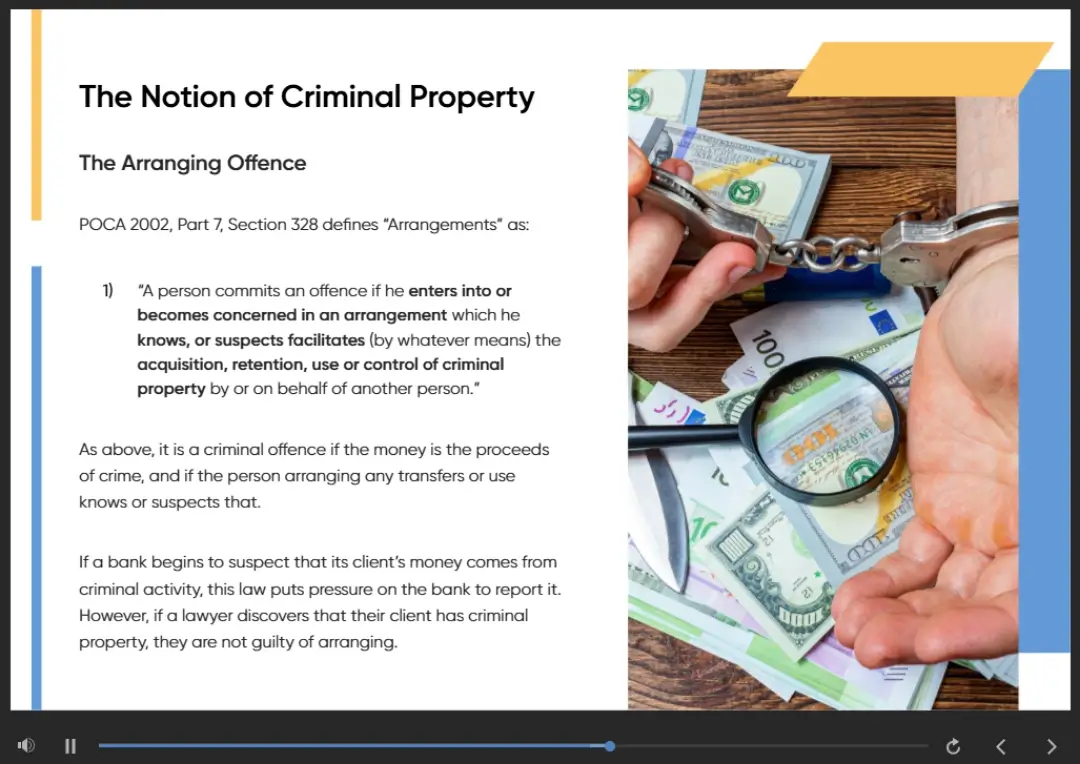
Learning Outcomes AML Training
By the end of the Anti-Money Laundering (AML) Training, learners will be able to:
- Learning Outcomes AML Training
- Demonstrate knowledge of the role of a money-laundering report officer
- Assess client risk and conduct a thorough client risk assessment
- List the main elements of a customer due diligence program
- Detect unusual transactions and suspicious activity
- Show awareness of staff responsibility and training requirements
- Identify the different types of events that might cause suspicion
Who Should Take The Anti Money Laundering Course
This Anti-Money Laundering Course is ideal for anyone looking to kickstart a career in this field or who wants to gain a deeper understanding of money laundering and how to prevent it. That includes:
- Money Laundering Reporting Officer
- AML Analysts
- AML Officer
- Risk & Compliance Analyst
- Compliance Manager
Assessment
At the end of the AML Training Course, there will be an online assessment, which you will need to pass to complete the course. Answers are marked instantly and automatically, allowing you to know straight away whether you have passed. If you haven’t, there’s no limit on the number of times you can take the final exam. All this is included in the one-time fee you paid for the course itself.
Certification
Once you’ve successfully completed your Anti-Money Laundering Training Course, you will immediately be sent a digital certificate. Also, you can have your printed certificate delivered by post. All of our courses are fully accredited, providing you with up-to-date skills and knowledge and helping you to become more competent and effective in your chosen field.
Course Curriculum
The detailed curriculum outline of our online anti money laundering training (AML Training) is as follows:
In this introductory module, we will develop our understanding of what money laundering is and will explore the three stages of money laundering in detail.
In module two, we will learn the principles of the Proceeds of Crime Act and discuss the notions and elements of criminal property. It covers the concealing offence, arranging office and the Acquisition, Use and Possession Offence.
In module three, we will familiarise with terrorist legislation and take a more in-depth look at The Proceeds of Crime Act 2002. It provides essential information on the second, third, fourth and fifth Money Laundering Directive.
In module four, we will learn about the role of the money laundering reporting officer and the information that needs to be included in the MLRO’s Annual Report. It also covers internal reporting procedures.
In module five, we will develop our understanding of customer due diligence and the main factors to consider when determining AML risk. It also provides step-by-step guidance on how to assess client risk.
In module six, we will explore the key elements needed in a customer due diligence program, from account opening to customer identification and verification. It also covers consolidated KYC risk management.
In module seven, we will look at record-keeping procedures and best practice, including in what form records should be kept and the consequences of failure to keep records.
In module eight, we will gain an in-depth understanding of what constitutes suspicious activity and what to do if customer activity appears suspicious, as well as the types of events that may cause suspicion.
In module nine, we will take a look at the legal requirements for staff training and awareness, including the responsibilities of senior staff. A wide range of training methods will be explored, as well as key assessment procedures.
FAQs About Anti Money Laundering Training
Anti-money laundering (AML) checks are procedures used by financial institutions and businesses to prevent, detect, and report money laundering activities. These checks verify customer identities, monitor transactions for suspicious patterns, and ensure compliance with regulations like the Bank Secrecy Act or FATF guidelines. Common steps include Know Your Customer (KYC) verification, screening against sanction lists, and analyzing large or unusual transactions. AML checks protect against financial crimes, such as fraud or terrorism financing, by ensuring funds come from legitimate sources. They’re critical for banks, crypto exchanges, and even real estate firms. Non-compliance can lead to hefty fines or legal action. By implementing robust AML checks, businesses safeguard their operations and contribute to a secure financial system.
Anti-Money Laundering (AML) regulations are laws and policies designed to prevent criminals from disguising illegally obtained funds as legitimate income. These rules require financial institutions, like banks and crypto exchanges, to monitor transactions, verify customer identities, and report suspicious activities to authorities. AML laws, such as the Bank Secrecy Act in the U.S. or the EU’s AML Directives, aim to combat money laundering, terrorist financing, and fraud. Businesses must implement Know Your Customer (KYC) checks and maintain detailed records to ensure compliance. Non-compliance can lead to hefty fines or legal action. By enforcing transparency, AML regulations protect the financial system’s integrity and public safety, making it harder for illicit funds to flow undetected.
Anti-money laundering (AML) laws are regulations to stop criminals from hiding illegal funds as legitimate income. They require banks, crypto exchanges, and other financial institutions to verify customer identities, monitor transactions, and report suspicious activities to authorities. AML laws fight money laundering, terrorist financing, and financial crimes. Key elements include Know Your Customer (KYC) checks and compliance with laws like the U.S. Bank Secrecy Act or EU AML Directives. These laws ensure transparency, protect financial systems, and enhance public
Anti-money laundering (AML) guidelines are regulations designed to prevent criminals from disguising illegally obtained funds as legitimate income. These rules, enforced by governments and financial institutions, require banks, businesses, and professionals to monitor transactions, verify customer identities, and report suspicious activities. Key components include Know Your Customer (KYC) protocols, transaction monitoring, and compliance with laws like the Bank Secrecy Act or FATF standards. AML guidelines aim to combat financial crimes such as terrorism financing, fraud, and drug trafficking. Businesses must train staff, maintain records, and use advanced technology to detect unusual patterns. Non-compliance can lead to hefty fines or legal action. By following AML guidelines, organizations protect the financial system’s integrity and ensure transparency.
To earn an Anti-Money Laundering (AML) certificate, enroll in a reputable course like the one offered by Training Express. Their AML training covers regulations, risk assessment, and compliance. Upon completing the course, learners receive a free CPD-accredited certificate, recognized by employers and regulators. The course is online, flexible, and designed for professionals in finance, law, or compliance. Unlike competitors, Training Express ensures CPD accreditation, enhancing career credibility. Register, complete the modules, pass assessments, and download your certificate instantly. Stay compliant and boost your resume with this industry-standard qualification in under a week.
The cost of an Anti-Money Laundering (AML) certificate varies by provider. Training Express offers a free CPD-accredited certificate upon completing their Anti-Money Laundering course, making it an excellent choice for budget-conscious learners. Other providers like ACAMS charge $500-$1,500 for foundational certificates, while ICA courses may cost $1,000-$2,000, including membership fees. Free options like Training Express are ideal for everyone.
To ensure compliance with the latest safety regulations and best practices, course content should be reviewed and updated periodically.
To ensure compliance with the latest safety regulations and best practices, course content should be reviewed and updated periodically.

$45.54
$67.28
-
LevelBeginner
-
Total Enrolled4
-
Duration4 hours2 minutes
-
Last UpdatedSeptember 16, 2026
Hi, Welcome back!
Enrolled:4


Student Ratings & Reviews
4.0
Total 1 Rating
5
0 Ratings
4
1 Rating
3
0 Ratings
2
0 Ratings
1
0 Ratings